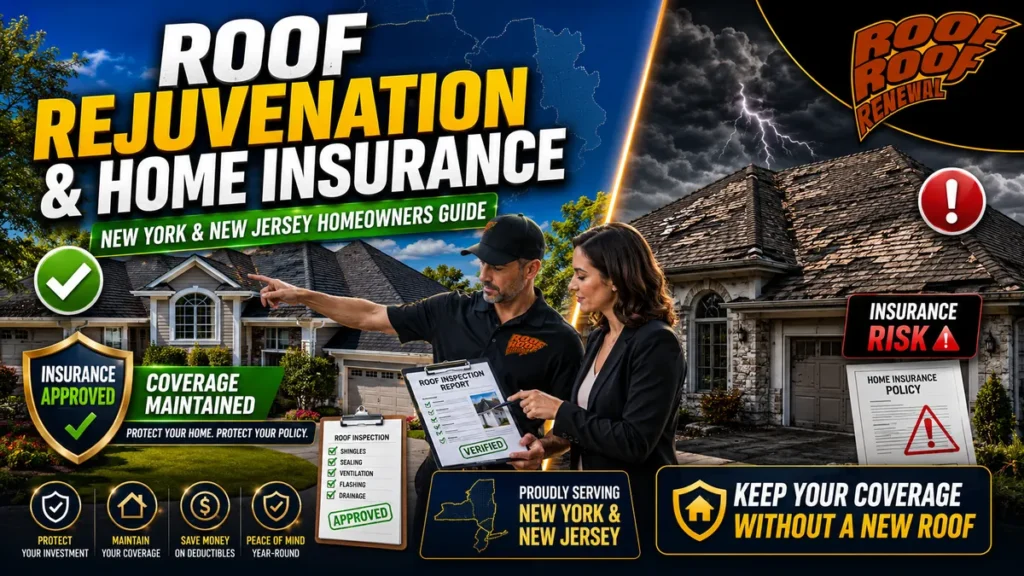
Homeowners across New York and New Jersey are getting letters no one wants to open: pass a roof inspection, replace your roof, or lose your coverage. Insurers are tightening rules around roof age, and a structurally fine 15- or 18-year-old roof can suddenly become an insurance problem.
Roof rejuvenation and home insurance intersect in a way most homeowners have never heard of: a rejuvenation treatment paired with a documented professional inspection can help your roof pass insurer scrutiny, without spending $15,000 or more on a premature replacement.
In this blog, we explain why insurers care about roof age, what is happening in the New York and New Jersey insurance market, how rejuvenation plus inspection documentation works, and the exact steps to protect both your roof and your policy.
Why Insurers Care So Much About Roof Age
Roofs are one of the biggest sources of claims in the Northeast. Nor’easters, ice dams, freeze-thaw cycles, and summer UV exposure age asphalt shingles hard in New York and New Jersey.
From an insurer’s perspective:
- Older shingles are brittle and fail more often in wind and ice events
- Roof claims are expensive and frequent
- Age is the easiest proxy they can underwrite against
What’s Happening in the NY & NJ Insurance Market
If you own a home in Bergen County, Passaic County, Rockland County, or Nassau County, here is what carriers are increasingly doing:
- The 20-year wall: Industry reporting confirms many insurers will not renew policies on roofs older than about 20 years unless the roof passes an inspection, and some will not write them at any price.
- Inspection demands starting early: Some carriers begin requesting inspection documentation and photos around the 10-year mark.
- Premium hikes: Premiums typically rise 15–30% once a roof passes 15 years, and can double at 20+.
- Quiet coverage downgrades: Many policies are switched from full replacement cost to actual cash value (ACV) on the roof, meaning depreciation comes out of your claim payout. Check your declarations page; this often happens at renewal without homeowners noticing.
Notice what all of these have in common: the deciding factor is documented roof condition, not just the number on the calendar. That is exactly the gap roof rejuvenation is built to close.
Insurance rules and carrier practices change and vary by policy. Always confirm specifics with your carrier or agent.
Also Read: How Long Does A Roof Last?
Roof Rejuvenation and Home Insurance: How to Keep Your Coverage
Rejuvenation does not change your roof’s age on paper. What it changes is the two things that actually matter: the roof’s real condition and what an inspector writes down.
Step 1: The Treatment Restores Real Condition
A soy-based rejuvenation treatment replaces the oils that sun, ice, and weather strip out of asphalt shingles. Flexibility returns, granule loss slows, and the roof’s functional lifespan extends by roughly five years per application.
Step 2: The Inspection Documents It
When your carrier requires a roof inspection, the difference between passing and failing is the shingles’ actual condition: flexibility, granule retention, sealing, and flashing integrity. A professionally maintained and treated roof, with inspection photos and a written condition report, gives your insurer documented evidence instead of an assumption based on age.
Step 3: You Present It to Your Carrier
Send the condition report to your carrier or agent and ask them to underwrite based on documented condition and maintenance history. Many homeowners resolve an inspection demand or non-renewal notice this way for a fraction of what a new roof costs. If your carrier still declines, that documentation also strengthens your application with other insurers.
The Cost Comparison: Rejuvenation vs. Forced Replacement
| Rejuvenation + Documentation | Premature Replacement | |
|---|---|---|
| Typical cost | $1,300 – $2,500 | $8,000 – $20,000+ |
| Timeline | Days | Weeks (quotes, permits, install) |
| Insurance outcome | Documented condition and remaining life | Coverage retained |
| Waste | None, existing shingles preserved | Tons of landfill debris |
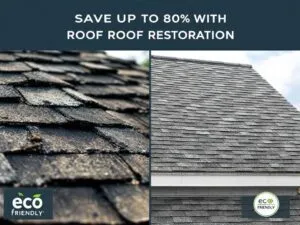
Both paths can satisfy your insurer. One costs up to 80% less and keeps a perfectly serviceable roof out of the landfill.
A note for Florida homeowners: our St. Petersburg team serves the Tampa Bay area, where state insurance reforms add an extra advantage: carriers there generally cannot refuse coverage based on the age of an asphalt shingle roof alone if a qualifying inspection shows five or more years of useful life remaining.
What Insurance Does (and Does Not) Cover
To set expectations clearly:
- Insurance will not pay for rejuvenation itself. It is classified as maintenance, like gutter cleaning or pressure washing.
- Insurance covers sudden peril damage: windstorms, hail, fallen trees, ice damming (policy-dependent), lightning.
- Insurance does not cover wear and tear, and a poorly maintained roof can even jeopardize a storm claim.
That last point cuts both ways: documented maintenance like rejuvenation strengthens your position if you ever do need to file a storm claim, because it shows the roof was cared for.
Action Plan If You Received a Roof-Age Letter
- Don’t panic-buy a roof. A non-renewal or inspection notice is a deadline, not a verdict.
- Check your declarations page for a quiet switch to ACV roof coverage.
- Get a free professional inspection to establish your roof’s true condition.
- If your roof qualifies, schedule rejuvenation and keep the full documentation: before/after photos and the condition report.
- Send the documentation to your carrier or agent, or use it to shop other carriers.
- If your roof doesn’t qualify, get honest repair or replacement guidance before your renewal date.
Frequently Asked Questions (FAQs)
They can decline to renew, and roof age is one of the top reasons for non-renewals in NY and NJ right now, especially past the 20-year mark. But most carriers base the final decision on an inspection. A well-maintained, professionally treated roof with documented condition has a far better chance of passing than an untreated one of the same age.
No. Rejuvenation is preventive maintenance, and insurance covers sudden damage from perils like wind and hail, not upkeep. However, rejuvenation can help your roof pass insurer inspections and typically costs 80% less than the replacement an insurer might otherwise push you toward.
It generally helps. Documented professional maintenance shows the roof was properly cared for, which supports your position in a claim. Insurers deny claims over neglect and wear, not over maintenance.
Final Thoughts – Roof Rejuvenation and Home Insurance
A roof-age letter from your insurer feels like a $15,000 problem, but for many New York and New Jersey homeowners it is actually a $2,000 one. If your asphalt roof is structurally sound, rejuvenation plus professional inspection documentation can restore real condition, prove remaining life, and give your carrier what it needs.
The first step costs nothing: find out what condition your roof is actually in before making any decisions your budget will feel for years.
| Got a Roof-Age Letter From Your Insurer? Serving homeowners across Bergen County, Passaic County, Rockland County, Nassau County, and the Tampa Bay area, Roof Roof Renewal offers a FREE inspection to determine if rejuvenation can save your coverage, and your budget. Eco-friendly soy-based treatment, transparent pricing from $1.19/sq ft. Schedule your free inspection or call (954) 278-7164. |